
Home > On-Demand Archives > Talks >
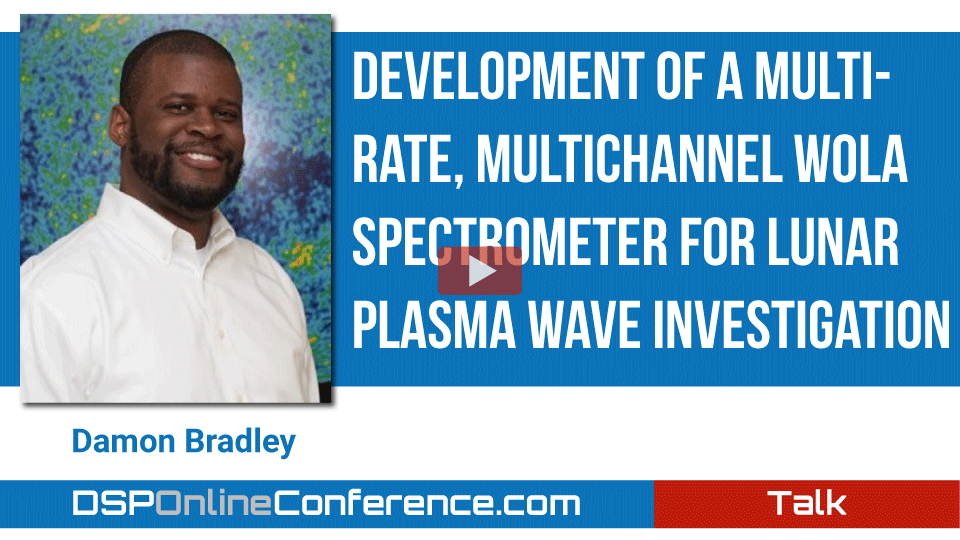
Development of a Multirate, MultiChannel WOLA Spectrometer for Lunar Plasma Wave Investigation
Damon Bradley - Watch Now - DSP Online Conference 2021 - Duration: 01:00:11
This guide was created with the help of AI, based on the presentation's transcript. Its goal is to give you useful context and background so you can get the most out of the session.
What this presentation is about and why it matters
This talk walks through the design and FPGA implementation of a multirate, multichannel WOLA (weighted overlap-add) spectrometer built for a lunar plasma‑wave experiment. It connects practical DSP building blocks (half‑band decimators, CIC decimators with FIR compensation, polyphase filter‑bank FFTs, CORDIC magnitude engines, and vector averaging) with real constraints of space hardware: limited FPGA area, fixed telemetry bandwidth, analog front‑end limits, and radiation‑hardened parts.
Why it matters for engineers: the presentation is a compact case study in turning DSP theory into a flight instrument under tight schedule, power, and resource constraints. It shows how to choose algorithms that map efficiently onto FPGA fabric, how multirate techniques enable a "zoom" spectrometer, and how to validate and iterate a design quickly using model‑based tools (Simulink HDL Coder). These are practical lessons for anyone implementing real‑time signal processing in constrained embedded systems.
Who will benefit the most from this presentation
- FPGA and digital hardware engineers who implement high‑throughput DSP blocks.
- DSP engineers building real‑time spectrometers, channelizers, or radio receivers.
- Embedded systems designers working with ADCs, LVDS interfaces, and multichannel data paths.
- Graduate students and researchers in radio astronomy or space instrumentation wanting a systems perspective.
- System architects who must trade algorithm performance against resource and telemetry constraints.
What you need to know
To get the most out of the presentation, be comfortable with these concepts and why they are used:
- Sampling and aliasing: When you downsample (decimate), you must remove out‑of‑band content first to avoid aliasing. The speaker uses an analog front end plus a digital half‑band filter to prepare for decimation by 2.
- FFT bin spacing: For an N‑point FFT running at sample rate $F_s$, the frequency spacing is $\Delta f = F_s / N$. The talk uses 512 unique bins (from a 1024‑point real FFT), so the choice of $F_s$ and $N$ determines resolution in high and zoom modes.
- WOLA / polyphase filter‑bank: Weighted overlap‑add implements a short‑time Fourier transform with windowing and 50% overlap. A prototype FIR is split into polyphase branches to form an efficient channelizer that feeds the FFT bins. WOLA reduces spectral leakage while keeping computation manageable for streaming data.
- Half‑band polyphase filters: Half‑band FIRs decimate by two with many zero coefficients (every other coefficient is zero), enabling efficient polyphase implementations and fewer multipliers in FPGA logic.
- CIC decimators and compensation FIRs: CIC filters are multiplier‑free, efficient decimators with a sinc‑like passband (droop). You must follow a CIC with a compensating FIR to flatten the passband (and optionally correct gain).
- CORDIC magnitude: CORDIC provides a hardware‑efficient way to compute vector magnitude (and other trig functions) using shifts and adds, avoiding multipliers and square‑root units in fixed‑point hardware.
- Vector (block) averaging): Averaging consecutive spectra reduces variance/noise. Implementing this in hardware requires careful accounting of memory FIFO latency and pipeline timing so blocks align correctly before accumulation.
- Model‑based flow and fixed‑point effects: Using Simulink HDL Coder to generate RTL accelerates iterations, but you still must optimize fixed‑point widths, pipeline stages, and resource use to fit an FPGA budget.
- System constraints: Multiple identical DSP channels, shared FPGA resources, telemetry limits (e.g., 16 kbps downlink), and environmental robustness (thermal/vibration) drive practical choices in algorithm complexity and data reduction.
Glossary
- WOLA (Weighted Overlap‑Add): A windowed STFT implementation that overlaps successive frames and adds the windowed results to form a spectrogram with reduced leakage.
- Polyphase filter bank: A structure that splits a prototype FIR into phases so it can act as an efficient multichannel channelizer before an FFT.
- FFT (Fast Fourier Transform): Algorithm to compute discrete Fourier transform efficiently; here used as the core of each spectrometer bin.
- Half‑band filter: An FIR decimator with cutoff at $F_s/4$ whose coefficients are partially zero, enabling efficient decimation by 2.
- CIC (Cascaded Integrator‑Comb) filter: Multiplier‑free decimator/interpolator with sinc‑like response used for large integer decimation ratios.
- Compensation FIR: A finite‑impulse‑response filter placed after a CIC to flatten passband droop and shape the response.
- CORDIC: Coordinate Rotation Digital Computer — iterative (or pipelined) shift‑and‑add algorithm to compute magnitudes and trigonometric functions in hardware.
- ADC (Analog‑to‑Digital Converter): Converts analog antenna voltages to digital samples; here running at 120 MHz and interfaced via LVDS.
- Stacer antenna / dipole: Simple deployable monopole/dipole antenna used on the lander to sample electric fields above the lunar surface.
- Vector averager: Hardware block that accumulates and averages successive complex spectra to reduce variance and reveal persistent signals.
Final notes
Damon Bradley's talk is a concise, practical walkthrough of how classical DSP building blocks are combined and tuned to meet stringent hardware and mission constraints. If you want a real example of multirate design, resource trade‑offs on space‑grade FPGAs, and how model‑based design can accelerate delivery, this presentation is a highly useful and motivational case study. Expect concrete implementation details and candid notes about the iterations that made the instrument flight‑ready.
Thank you so much SlightlyChaotic! I'm very happy that you profited from my talk. Thank you for the kind words. I've taught DSP many times at the undergrad and graduate level, but will definitely take your suggestion in writing tutorials! Cheers!
Just want to note - if you haven't seen it yet, please check out my former colleague and future Dr. Asmita Korde's presentation on compressive sensing! She's using it to discover new exoplanets in a very unique and novel application!
Great presentation!
Thank you so much!
Really appreciate the talk, thanks! I especially profited from the detail and step-by-step explanations of the DSP-related sections, as well as the references to other helpful webpages. I imagine you would be good at writing tutorials from introductory to advanced.